The photograph below is a CPDB plate from an IIC build. Most of it repeats the datasheet. Three cells on it decide whether the forklift can enter your plant.
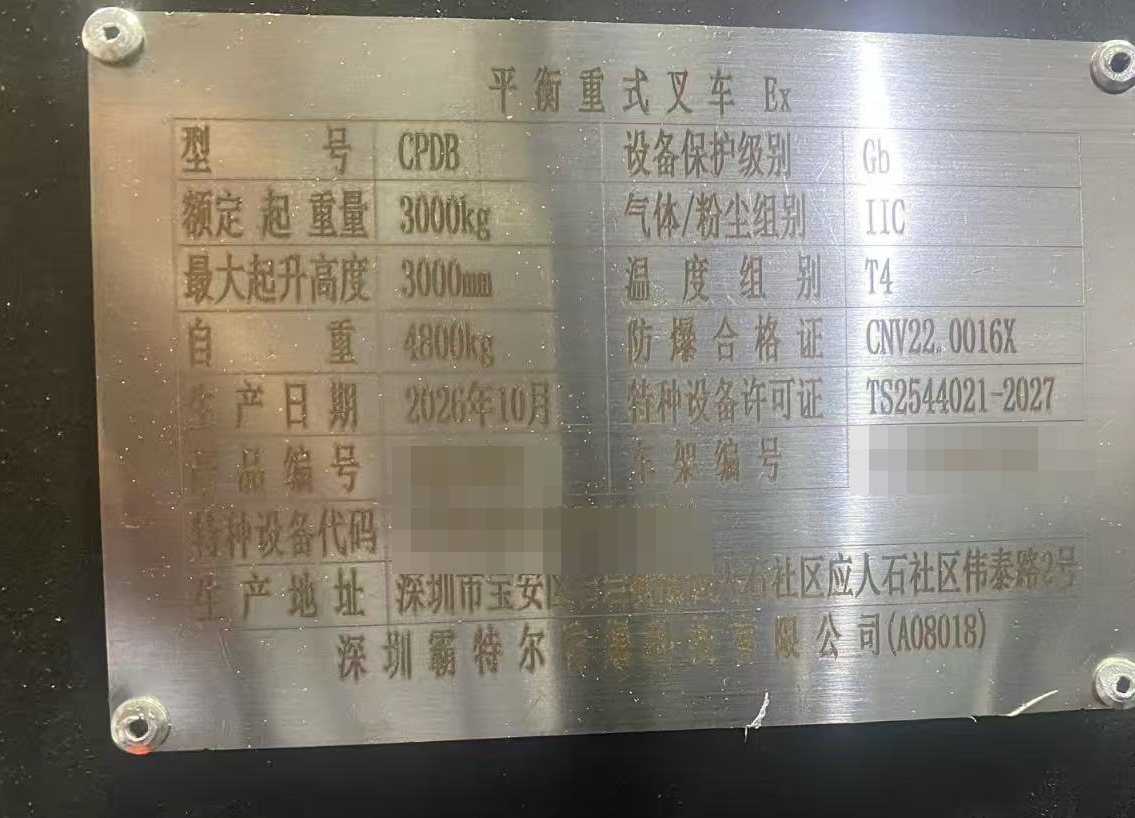
The plate is engraved in Chinese. The table restates it in English, in the order the fields appear.
| Field | Value |
|---|---|
| Equipment type | Counterbalance forklift, Ex |
| Model | CPDB |
| Equipment protection level (EPL) | Gb |
| Rated capacity | 3,000 kg |
| Gas / dust group | IIC |
| Maximum lift height | 3,000 mm |
| Temperature class | T4 |
| Service weight | 4,800 kg |
| Explosion-proof certificate | CNV22.0016X |
| Date of manufacture | October 2026 |
| Special equipment manufacturing licence | TS2544021-2027 |
| Product number | redacted |
| Frame number | redacted |
| Special equipment code | redacted |
| Manufacturing address | Bao'an District, Shenzhen, Guangdong, China |
| Manufacturer | Bater (plate code A08018) |
Gb, IIC, T4. Read together, they say the forklift is cleared for Zone 1 and Zone 2, for gases up to group IIC, with no surface above 135 °C. The same plate names the certificate, CNV22.0016X, and the special equipment licence behind it. What it does not print is the run of protection letters, because those live on the certificate and on the plates of the individual components.
The IIB and IIIB configuration is certified with two full lines for the same forklift. Read the rest of this article against those two lines:
The first line is the gas declaration. The second is the dust declaration. A forklift certified for gas alone prints the first line only, so a plate with one line is a plate for a narrower explosion-proof forklift. A second line means a dust certificate exists behind it.
Read the gas line left to right
| Element | Reads | What it means |
|---|---|---|
| Ex | Ex | Built to explosion-protection standards. |
| db | Flameproof enclosure, level b | An internal ignition is contained inside a heavy housing. Hot gas escaping through the joint faces is cooled before it reaches the atmosphere. |
| ib | Intrinsic safety, level b | The circuit cannot release enough energy to ignite the atmosphere, whatever happens to it. |
| mb | Encapsulation, level b | Components are cast in resin, so the atmosphere never reaches them. |
| sb | Special protection, level b | A design measure for the parts that no standard enclosure type covers. On a forklift this covers the whole machine. |
| IIB | Gas group IIB | Cleared for IIA and IIB gases, which covers methane, ethylene and most solvent vapours. |
| T4 | Temperature class T4 | No surface above 135 °C. |
| Gb | Equipment protection level Gb | Zone 1 and Zone 2. |
Four protection types, one forklift. The motor is flameproof, the control circuits are intrinsically safe, the electronics are encapsulated, and the forklift as a whole is assessed under special protection.
Then read the dust line
| Element | Reads | What it means |
|---|---|---|
| Ex | Ex | The same prefix, on a separate declaration. |
| tb | Protection by enclosure, level b | The housing keeps dust out and limits the surface temperature. |
| mb | Encapsulation, level b | The same cast-resin parts, counted again under the dust standard. |
| IIIB | Dust group IIIB | Non-conductive dust: grain, wood, plastic, most powders. |
| T130°C | Maximum surface temperature | Dust marking states the limit in degrees rather than as a T class. |
| Db | Equipment protection level Db | Zone 21 and Zone 22. |
The dust line states a temperature in degrees because dust behaves differently from gas. A layer of dust insulates the surface underneath it and lowers the temperature at which that surface ignites, so the certificate fixes a surface limit rather than a class.
Why four protection types appear on one plate
The motor, the controller and the luminaire each fit an existing type of protection. The forklift as a whole fits none: forks scrape the floor, tyres build static, brakes run hot, and none of those are electrical ignition sources that d, e or i can cover.
So each component is assessed under the type that fits it, and the remainder is assessed under special protection. That is what sb is doing at the end of the string. It covers what no existing type could, while db, ib and mb cover what they could.
Two component plates from the same explosion-proof forklift show the split in practice.
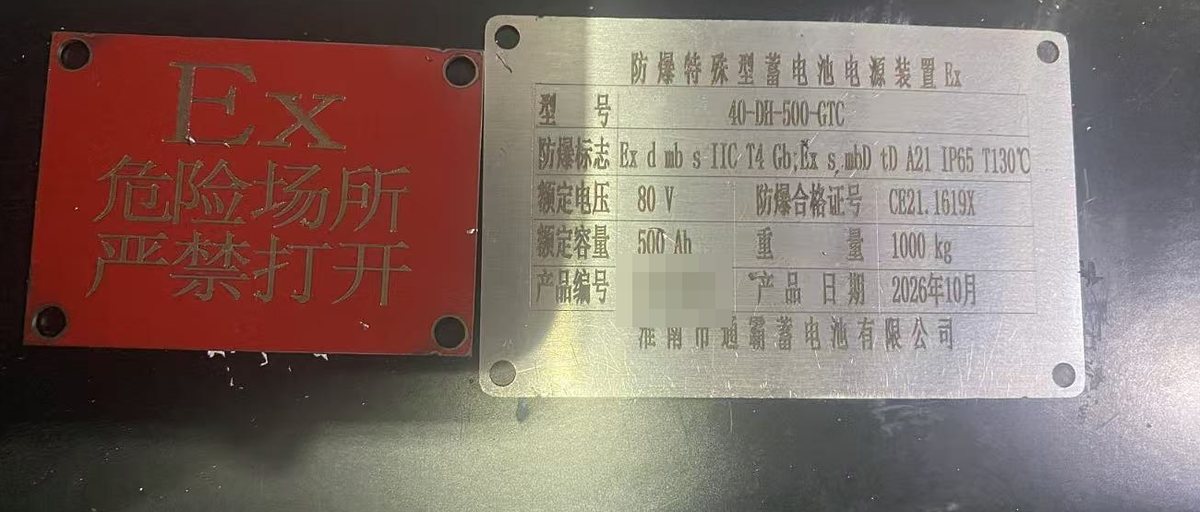
Ex d mb s IIC T4 Gb in one line. Three types, and s is one of them. That string could not exist if s replaced the other types instead of covering what they miss.| Field | Value |
|---|---|
| Equipment type | Explosion-proof special-type battery power unit, Ex |
| Model | 40-DK-560-ETC |
| Explosion-proof marking, gas | Ex d mb s IIC T4 Gb |
| Explosion-proof marking, dust | Ex s mbD tD A21 IP65 T130°C |
| Rated voltage | 80 V |
| Certificate number | CQ21.1691X |
| Rated capacity | 560 Ah |
| Weight | 1,000 kg |
| Product number | redacted |
| Date of manufacture | October 2026 |
| Manufacturer | Huainan Tongba Battery Co., Ltd. |
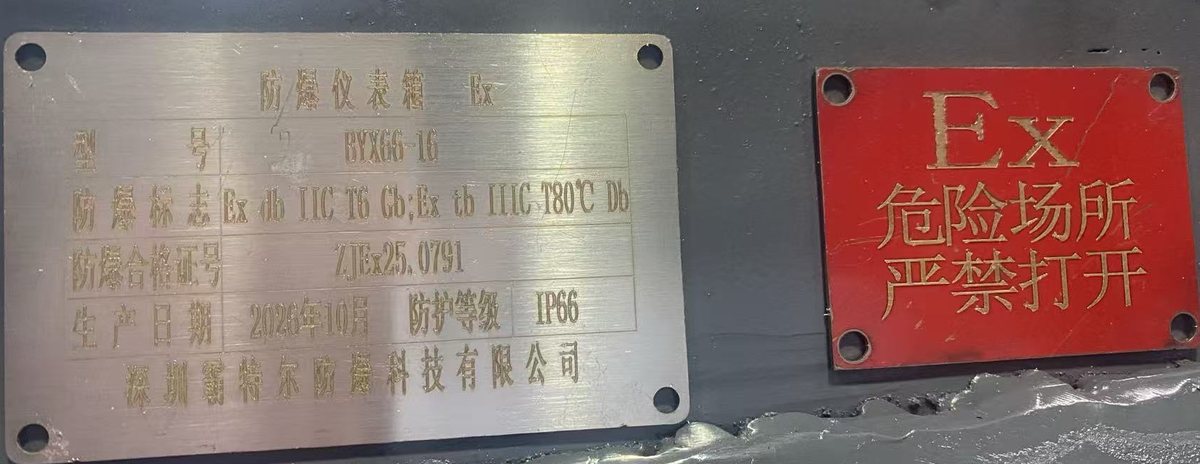
db and tb. They can also run to a higher group than the plate on the forklift, because a component certificate is issued for the component and does not change with the forklift around it. The red sign reads: hazardous area, do not open.| Field | Value |
|---|---|
| Equipment type | Explosion-proof instrument box, Ex |
| Model | BYX66-16 |
| Explosion-proof marking, gas | Ex db IIC T6 Gb |
| Explosion-proof marking, dust | Ex tb IIIC T80°C Db |
| Certificate number | ZJEx25.0791 |
| Date of manufacture | October 2026 |
| Ingress protection (IP) | IP66 |
| Manufacturer | Shenzhen Bater Explosion-proof Technology Co., Ltd. |
IEC 60079-33 settles it: special protection applies where equipment cannot entirely be assessed under the existing types or a combination of them. Whatever fits an existing type is still assessed under that type, so the two coexist in one string by design.
Special protection adds no margin over d. It exists for equipment no single standard type can cover, which is why almost every explosion-proof forklift carries it and almost no explosion-proof motor does.
The protection type: the letter after Ex
The letter tells you how the protection is achieved. There are more of these than most buyers expect.
| Code | Name | Standard | How it works |
|---|---|---|---|
| d | Flameproof enclosure | IEC 60079-1 | An internal ignition is contained. Hot gas escaping through the joints is cooled below ignition temperature before it reaches the outside |
| e | Increased safety | IEC 60079-7 | No arcs or hot spots in normal operation, plus extra measures on creepage and clearance |
| i | Intrinsic safety | IEC 60079-11 | The circuit itself cannot release enough energy to ignite the atmosphere |
| m | Encapsulation | IEC 60079-18 | Components are cast in resin |
| n | Type n | IEC 60079-15 | Incapable of ignition in normal operation. Zone 2 only |
| o | Oil immersion | IEC 60079-6 | Live parts are immersed in oil |
| p | Pressurization | IEC 60079-2 | The enclosure is held above atmospheric pressure with clean gas, so the atmosphere cannot get in |
| q | Powder filling | IEC 60079-5 | The enclosure is filled with sand or powder |
| s | Special protection | IEC 60079-33 | A design measure for equipment that the standard enclosure types cannot fully cover |
| t | Protection by enclosure | IEC 60079-31 | Dust atmospheres. A separate scheme from the gas types above |
Most of these carry a level letter as well, and the level is part of the marking. Flameproof runs da, db, dc. Intrinsic safety runs ia, ib, ic. Encapsulation runs ma, mb. Dust enclosure runs ta, tb, tc. Special protection runs sa, sb, sc. A marking that gives the type letter and drops the level is incomplete, and you should ask for the rest of it.
The equipment group: I, II or III
This is the split that decides which rulebook applies.
- Group I is mining.
- Group II is surface industry with flammable gas.
- Group III is dust, and it is a different system with its own sub-groups: IIIA for combustible flyings, IIIB for non-conductive dust, IIIC for conductive dust.
Group II and Group III are separate declarations with separate certificates. A forklift that holds both prints both lines, as ours does. A forklift with a gas certificate alone prints one line, and the dust in your plant does not change that.
The gas group: IIA, IIB or IIC
Gases are sorted by how easily a spark or a hot surface sets them off, using the maximum experimental safe gap and the minimum igniting current. IIA is the hardest to ignite, IIC the easiest.
Equipment rated for a higher group can be used in a lower group. The reverse never holds. A IIB forklift is fine in IIA or IIB service. In IIC service it is unsuitable, whatever the capacity says. The entire distance between IIB and hydrogen is half a millimetre of safe gap.
The group is a choice made when the order is placed, and each choice comes with its own certificate. IIB costs less to build, because the flameproof joint faces can be wider. IIC covers hydrogen and acetylene, and it covers IIB and IIA on the way down. Where the process list is still open, IIC is the version that survives a late addition to it.
The temperature class: T1 to T6
T4 means no surface of the equipment exceeds 135 °C. The class caps the maximum surface temperature of any part that can meet the atmosphere.
| Class | Maximum surface temperature |
|---|---|
| T1 | 450 °C |
| T2 | 300 °C |
| T3 | 200 °C |
| T4 | 135 °C |
| T5 | 100 °C |
| T6 | 85 °C |
The rule is a comparison: the equipment's maximum surface temperature has to stay below the ignition temperature of the gas. A lower-numbered class can be used where a higher-numbered one is required, because 135 °C is still below a 200 °C ceiling.
The last character decides the zone
A current marking ends with an equipment protection level: Ga, Gb or Gc for gas, Da, Db or Dc for dust. Gb covers Zone 1 and 2. Db covers Zone 21 and 22. This one character answers the question the buyer actually has.
| EPL | Zones it covers |
|---|---|
| Ga | 0, 1 and 2 |
| Gb | 1 and 2 |
| Gc | 2 |
| Da | 20, 21 and 22 |
| Db | 21 and 22 |
| Dc | 22 |
The level applies to the whole explosion-proof forklift, and the weakest component sets it. A forklift with three Gb parts and one Gc part is a Gc forklift, and it belongs in Zone 2. That is why the EPL sits at the end of the string: it summarises everything before it.
An older plate can stop at the temperature class and carry no EPL. Such a plate leaves the zone question to the certificate, and the certificate is a separate document you have to ask for. Put the EPL in the enquiry when you buy. If you sell into Europe, note that IEC 60079-0 has required the EPL at the end of the marking string since the 2017 edition. The price side of the same decision is covered in what drives the price premium. Which certificate a site gets inspected against, and where ATEX, IECEx and Division 1 each apply, is in the certification guide.
One other thing on the plate
Ingress protection. The IP number, for example IP65. First digit dust: 6 is dust-tight. Second digit water: 5 is protected against jets. It answers a different question from explosion protection, and a high IP rating says nothing about hazardous-area suitability.
What the nameplate leaves out
Whether the charging arrangement is compliant. A correctly marked forklift can sit in a non-compliant installation, because a lead-acid battery releases hydrogen while charging and the bay needs its own assessment. The plate covers the forklift, not the bay. In the UK that duty sits in DSEAR, on the employer who runs the site.
Whether your authority accepts the scheme. An ATEX plate, an IECEx plate and a Class I Division 1 plate are three separate certificates for the same forklift. Different market, different document. The certificates we hold are listed with the documentation package.
Whether the atmosphere is what you assumed. The plate says what the forklift is declared for, not whether the site's area classification is correct. That comes from the drawing, a separate document.