
Explosion-Proof Counterbalanced Forklifts
Counterbalanced battery and internal-combustion forklifts for controlled material handling in demanding industrial environments. The battery CPDB series covers 1,500 to 5,000 kg; internal-combustion configurations are a separate, featured part of the Bater range.
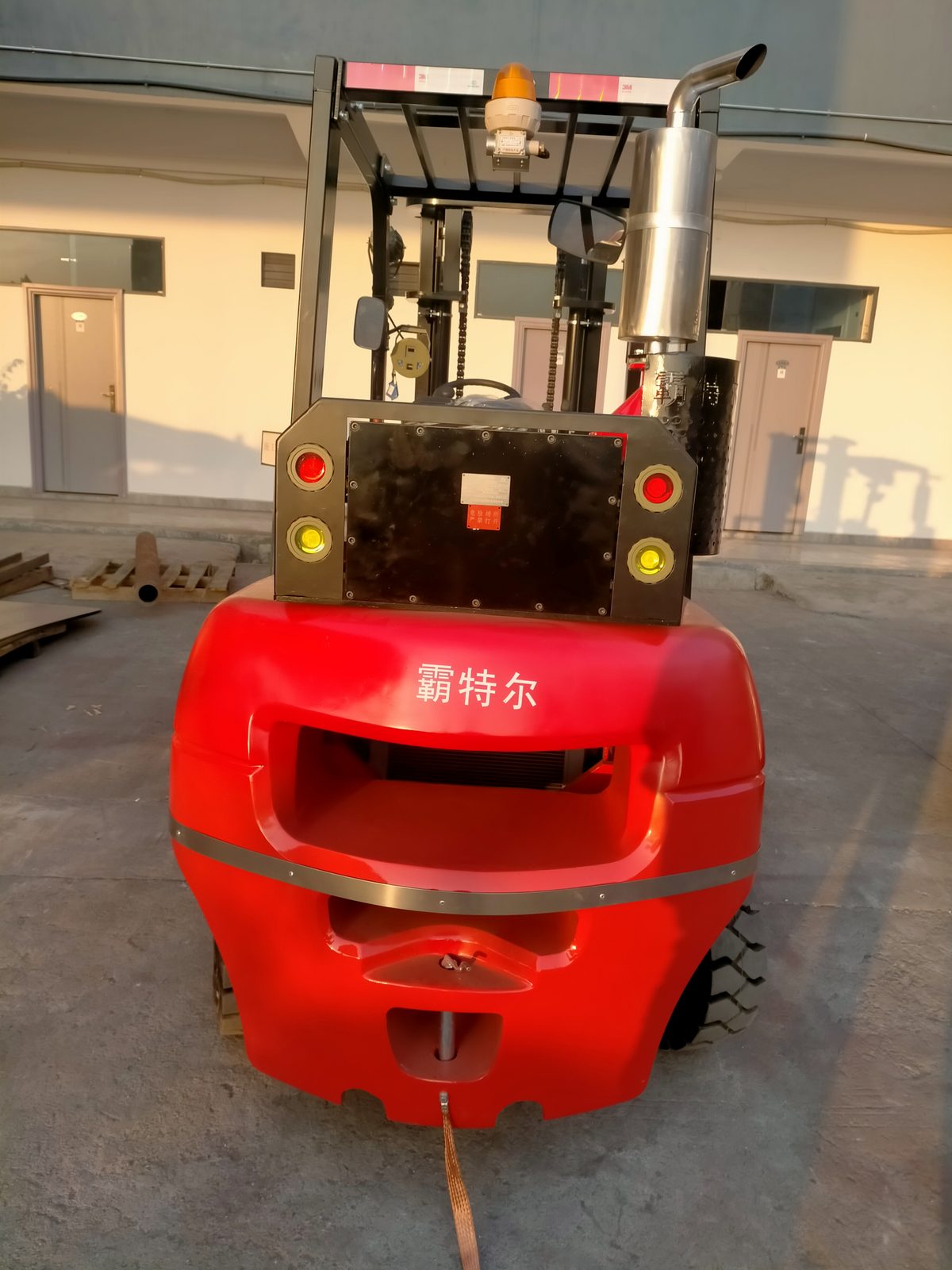
Four models, one platform logic.
The CPDB series is a battery counterbalanced family. Capacity, wheelbase and drive power scale together across the four models, so the choice between them is mostly a function of load, aisle geometry and floor condition rather than of preference.
Every model carries the same flameproof marking and the same Zone 1, 2 application-area declaration. What changes is the size of the machine, the battery pack and the amount of power available.
Alongside the battery range, Bater also supplies internal-combustion counterbalanced forklifts. The 3.5-ton internal-combustion vehicle is a featured Bater configuration — ask for a separate parameter sheet, as its ratings differ from the battery models tabulated above.
- 1,500 to 5,000 kg rated capacity in the battery CPDB series
- Battery and diesel power options in the documented range
- 3.5-ton internal-combustion vehicle as a featured configuration
- Flameproof marking and application-area documentation per model
- Anti-static tyres fitted as standard
CPDB series technical parameters.
Complete parameter comparison for the four CPDB models. Values are transcribed from the Bater technical parameter tables.
| Specification | CPDB15 | CPDB20 | CPDB30 | CPDB50 |
|---|---|---|---|---|
| Application area | Zone 1, 2 | Zone 1, 2 | Zone 1, 2 | Zone 1, 2 |
| Overall explosion-proof marking | Exsd II BT4 | Exsd II BT4 | Exsd II BT4 | Exsd II BT4 |
| Rated load capacity (kg) | 1,500 | 2,000 | 3,000 | 5,000 |
| Load centre distance (mm) | 500 | 500 | 500 | 500 |
| Maximum lifting height (mm) | 3,000 | 3,000 | 3,000 | 3,000 |
| Free lift height (mm) | 135 | 145 | 145 | 145 |
| Fork length (mm) | 1,070 | 1,070 | 1,070 | 1,070 |
| Mast tilt angle, forward / back (°) | 6/12 | 6/12 | 6/12 | 6/9 |
| Overall dimensions L×W×H (mm) | 3,178×1,095×2,075 | 3,275×1,150×2,200 | 3,590×1,240×2,160 | 4,030×1,580×2,260 |
| Minimum turning radius (mm) | 1,970 | 2,050 | 2,250 | 3,150 |
| Maximum travel speed, laden / unladen (km/h) | 13/11 | 13/11 | 12/10 | 15/13 |
| Lifting speed, laden / unladen (mm/s) | 400/260 | 400/270 | 380/260 | 340/220 |
| Maximum gradeability (%) | 10 | 10 | 10 | 14/13 |
| Wheelbase (mm) | 1,370 | 1,500 | 1,600 | 2,000 |
| Track width, front / rear (mm) | 890/920 | 960/950 | 1,000/970 | 1,190/1,270 |
| Minimum ground clearance (mm) | 105 | 115 | 110 | 110 |
| Motor power, travel / lift (kW) | 6.5/8.6 | 6.5/8.6 | 10.2/10 | 9×2/10×2 |
| Tyre type, front / rear (anti-static) | 6.50-10 / 5.00-8 | 7.00-12 / 18×7-8 | 28×9-15 / 18×7-8 | 28×12.5-15 / 7.00-12 |
| Battery pack (V / A·h) | 48/420 | 48/630 | 80/500 | 80/700 |
| Service weight (kg) | 3,100 | 4,100 | 5,200 | 7,000 |
Specifications may vary by configuration. Explosion-proof marking, application area and documentation must be confirmed for the selected vehicle and target market. Where the source table gives two values separated by a slash, the order is as published.
Reading the explosion-proof marking.
The CPDB series is marked Exsd II BT4. Each element carries a specific meaning, and reading them correctly is the difference between a suitable vehicle and an unsuitable one.
- Ex
- Marks the equipment as explosion-protected. Every element that follows describes how that protection is achieved.
- d
- Flameproof enclosure. Internal ignition is contained by the housing and cannot propagate to the surrounding atmosphere.
- s
- Special protection type. The exact scope depends on the specific standard and certificate — it must be read from the vehicle nameplate and the explosion-proof certificate for that unit.
- II
- Equipment Group II — surface (non-mining) industry, for areas where gas or vapour can form an explosive atmosphere.
- B
- Gas group IIB. The vehicle is declared for IIB gases, a narrower scope than the wider IIA/IIB/IIC band.
- T4
- Temperature class T4 — maximum surface temperature not exceeding 135 °C, which corresponds to equipment protection level Gb.
A note on accuracy: Exsd II BT4 is a transcription of the marking as it appears in Bater's materials. It is not the most common way the designation is written in full, and the meaning of the s element in particular depends on the standard and certificate that apply to the specific unit. Always confirm the marking against the vehicle nameplate and the explosion-proof certificate before relying on it for a purchase decision.
What the application area actually covers.
Zone 1 describes a location where an explosive gas atmosphere is likely to occur during normal operation. Zone 2 describes a location where it is not expected during normal operation, and if it does occur, it persists only for a short period.
A vehicle declared for Zone 1 and 2 is therefore relevant to the majority of classified process areas in chemical, pharmaceutical and paint plants. It does not follow that it is suitable for every part of every plant — Zone 0 areas, dust atmospheres and higher temperature classes sit outside this declaration and need a separate review.
Where each CPDB model fits.
- CPDB15
- 1,500 kg and 3,100 kg service weight. The lightest package in the range, with the tightest 1,970 mm turning radius — usually the practical choice where aisles are narrow.
- CPDB20
- Same 6.5/8.6 kW drive and 48/630 battery as the CPDB15 with 500 kg more capacity. Clearance rises to 115 mm, which matters on uneven floors.
- CPDB30
- Steps up to 10.2/10 kW motors and an 80/500 battery pack. Lifting speed drops slightly against the CPDB20, and the footprint widens to 3,590 mm.
- CPDB50
- 5,000 kg on a 2,000 mm wheelbase with twin 9 kW travel motors and an 80/700 pack. Service weight of 7,000 kg means floor loading and ramp grade need checking before selection.
Start with the operating environment.
Share your application, load requirements and target market. Our team can help identify a suitable vehicle configuration and documentation package.